Superb Bird of Paradise — The ‘Smiley Face’ of Papua
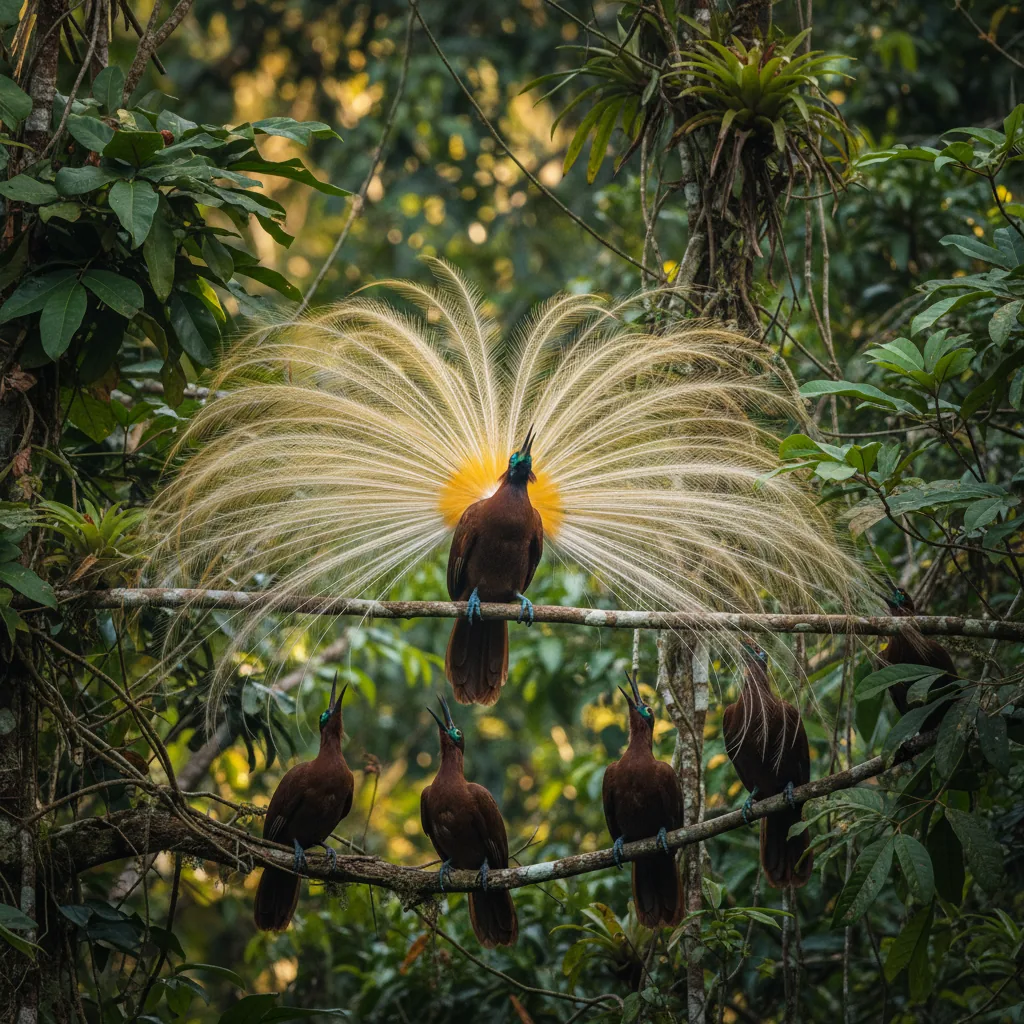
The Superb Bird of Paradise (Lophorina superba) became an internet sensation when BBC wildlife footage revealed its extraordinary secret: when displaying to a female, this small black bird transforms itself into an impossibly vivid ‘smiley face’ — an illusion created by the precise geometric arrangement of electric-blue feather patches against a deep black background. This viral phenomenon introduced millions of people worldwide to Papua’s extraordinary avian diversity, and for good reason: the Superb Bird of Paradise’s display is one of the most visually startling behaviours in the entire animal kingdom.
The Spectacular Display
The male Superb Bird of Paradise appears, at first glance, to be a modest glossy black bird with a velvety blue-green crown and iridescent chest shield. But when a female enters his territory, he undergoes a breathtaking transformation: he spreads his cape feathers behind his head and expands his iridescent breast shield forward, simultaneously compressing his body into an oval. The result is a face-like pattern — two bright blue curved ‘eyes’ above a crescent-shaped ‘mouth’ — that pulses and shimmers as the male hops around the female in a rapid, precise courtship dance.
Behaviour & Biology
Scientists believe this ‘smiley face’ illusion may work by triggering an innate recognition response in the female’s brain — literally hijacking her neural wiring for face recognition. Evolutionary biologist Ed Scholes, who leads the Cornell Lab of Ornithology’s Birds-of-Paradise Project, describes it as the male creating ‘a new shape that doesn’t exist in nature’ — a feat of optical engineering achieved through millions of years of sexual selection.
Where & How to See Superb Bird of Paradise in Papua
Observing the Superb Bird of Paradise requires access to montane forests at 1,400-2,000 metres elevation. The Arfak Mountains of West Papua and the Owen Stanley Range in eastern New Guinea are the primary viewing destinations. Our highland bird watching tours include pre-dawn hikes to known lek sites where local guides have built comfortable observation hides.
Photography Tips for Bird of Paradise
Photographing the Superb Bird of Paradise requires patience, preparation, and the right equipment. We recommend arriving at lek sites at least 30 minutes before first light to allow the forest to settle before birds begin arriving. Avoid sudden movements, keep voices to a whisper, and dress in dark, neutral colours. A telephoto lens of 400-600mm is ideal for frame-filling shots; image stabilisation is essential in the low forest light. Our photography-focused tours include custom hide setups at active lek sites, allowing extended close-range sessions that produce magazine-quality imagery.
Camera settings to start with: ISO 800-3200 (adjust for light conditions), aperture f/4-f/5.6 (balance depth of field and light), shutter speed 1/250s minimum for freezing display movement. Shoot in RAW format for maximum post-processing flexibility. Our guides can advise on optimal settings for each specific location and time of day.
Conservation Status & Threats
Like all birds of paradise, the Superb Bird of Paradise faces mounting pressure from deforestation and habitat degradation. While the IUCN currently lists many species as Least Concern, population trends are downward in areas experiencing forest clearance for agriculture, logging, and palm oil development. Traditional hunting for feather headdresses, while greatly reduced since international protection in the 1920s, continues in some communities for ceremonial use.
Sustainable ecotourism represents one of the most powerful conservation tools available today. When local communities receive genuine economic benefit from living birds watched by tourists, they become the most effective guardians of both forest and wildlife. Every tour booked with Papua Bird of Paradise directly supports community ranger programmes, forest patrol activities, and local conservation education initiatives.
Our Bird Watching Tour Options
We offer a range of bird watching experiences tailored to different interests, timeframes, and fitness levels. Short 3-4 day introductory packages focus on one or two species at accessible lowland sites. Week-long comprehensive tours cover multiple habitats and species. Photography expeditions of 10-14 days include custom hides, multiple lek visits, and professional photography guidance from our specialist naturalist guides.
All our tours include: expert ornithologist-naturalist guide with 10+ years Papua field experience, community ranger accompaniment at lek sites, all local transport (chartered boat, 4WD, porter support), meals and accommodation (ranging from village homestays to luxury jungle lodges), all park and community entry fees, and 24/7 support via WhatsApp. Contact us at [email protected] or WhatsApp +628113809193 to discuss a custom itinerary.
Frequently Asked Questions
Is the ‘smiley face’ real or just an optical illusion?
It’s a genuine optical phenomenon created by real feathers, but it’s also an illusion in the sense that the ‘face’ doesn’t exist when the bird is at rest. The male’s display transforms his body shape and feather arrangement to create the face-like pattern only during active display — making it genuinely both real and illusory simultaneously.
Why did the Superb Bird of Paradise go viral online?
BBC’s Planet Earth II footage, broadcast in 2016, captured the full display in high definition for the first time and was widely shared on social media. The unexpected, almost alien quality of the display — the perfect geometric ‘face’ combined with the rapid hopping dance — made it one of the most-shared wildlife videos in history.
How high do I need to hike to see the Superb Bird of Paradise?
The primary habitat is above 1,400 metres. Our guided hikes typically start from highland villages at around 1,200 metres and ascend to established lek sites. The walk takes 45-90 minutes through stunning cloud forest.
Does the Superb Bird of Paradise display year-round?
Males display throughout the year but peak activity occurs during the breeding season from April to September. Cold, clear mornings at high altitude tend to produce the most energetic displays.
What distinguishes the different subspecies of Superb Bird of Paradise?
Recent research has split what was formerly considered one species into multiple distinct species based on differences in display behaviour, plumage details, and genetics. The Arfak Mountains population, Vogelkop, and eastern New Guinea birds show distinct differences. Our guides can explain these nuances in the field.
Ready to See Birds of Paradise in the Wild?
Let our expert naturalist guides take you deep into Papua’s rainforests for a life-changing wildlife encounter. All tours include expert ornithologist guide, chartered boat, meals, and full logistics support.