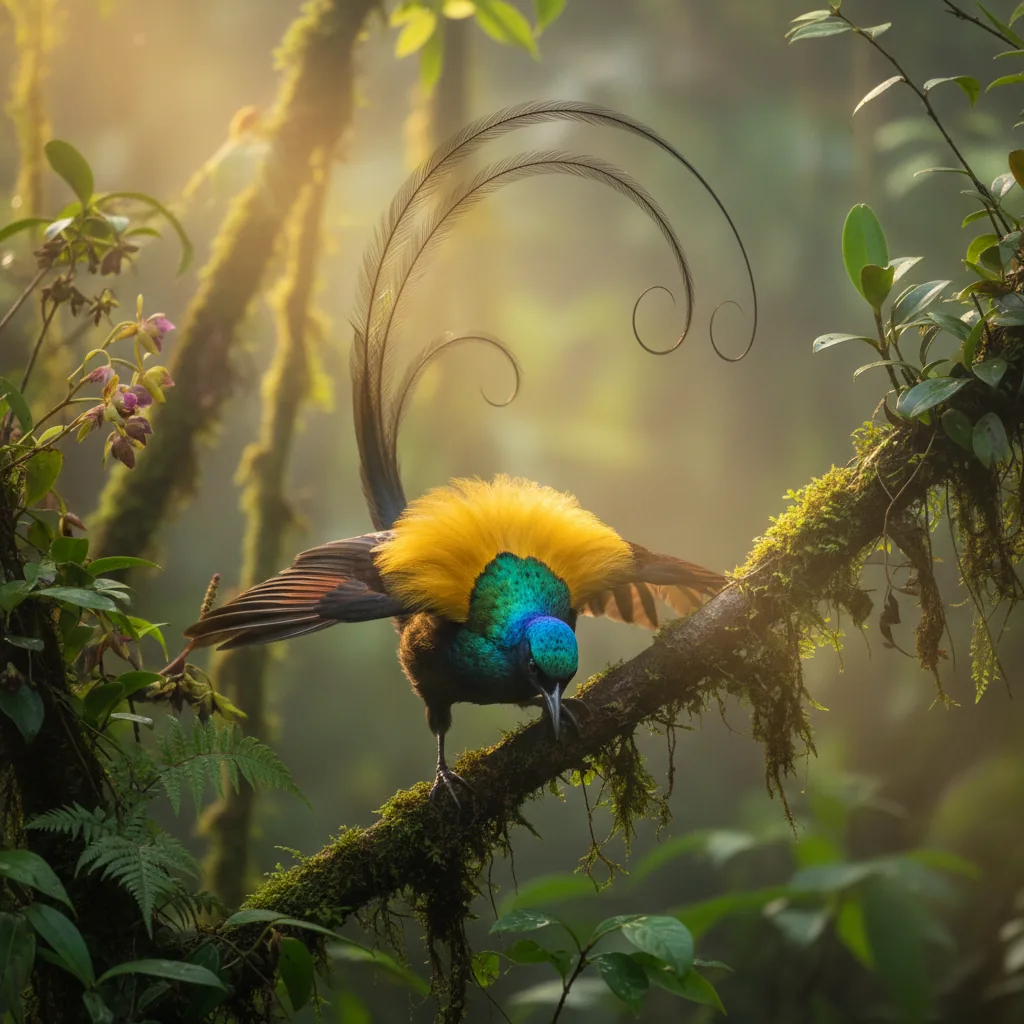
The Lesser Bird of Paradise (Paradisaea minor) is anything but ‘lesser’ in spectacle. Its name is a comparative one — it’s slightly smaller than its close relative the Greater Bird of Paradise — but its display is every bit as extraordinary. When multiple males gather at a communal lek and simultaneously erupt into a cascade of golden-yellow flank plumes, the effect is that of living gold dissolving into the rainforest air. It is one of the most reproduced images in wildlife photography and one of Papua’s most iconic wildlife encounters.
The Spectacular Display
The male Lesser Bird of Paradise is adorned with cascading flank plumes of pale yellow and white that emerge from beneath his wings and can extend dramatically beyond his tail during display. His bright yellow head, dark brown-maroon back, and iridescent emerald-green throat form the base of his ornamental outfit. At lek sites — which can contain 5 to 20 or more males — the birds gather daily at traditional display trees, engaging in competitive displays that can last for hours from before dawn until mid-morning.
Behaviour & Biology
The Lesser Bird of Paradise is one of the more accessible birds of paradise for visitors to Papua, as it inhabits a wide range of lowland and foothill habitats and tolerates forest edge environments somewhat better than other species. Known lek sites near villages in the Manokwari area, the Cyclops Mountains, and along the north coast of Papua have been documented by ornithologists and are regularly visited by our guided tour groups.
Where & How to See Lesser Bird of Paradise in Papua
Conservation of the Lesser Bird of Paradise is deeply intertwined with local community practices. In many areas, traditional taboos (sasi) have historically protected both the birds and their forest habitat. Our tours partner with these communities, ensuring that tourism revenue directly supports conservation efforts and provides economic alternatives to habitat-destructive industries.
Photography Tips for Bird of Paradise
Photographing the Lesser Bird of Paradise requires patience, preparation, and the right equipment. We recommend arriving at lek sites at least 30 minutes before first light to allow the forest to settle before birds begin arriving. Avoid sudden movements, keep voices to a whisper, and dress in dark, neutral colours. A telephoto lens of 400-600mm is ideal for frame-filling shots; image stabilisation is essential in the low forest light. Our photography-focused tours include custom hide setups at active lek sites, allowing extended close-range sessions that produce magazine-quality imagery.
Camera settings to start with: ISO 800-3200 (adjust for light conditions), aperture f/4-f/5.6 (balance depth of field and light), shutter speed 1/250s minimum for freezing display movement. Shoot in RAW format for maximum post-processing flexibility. Our guides can advise on optimal settings for each specific location and time of day.
Conservation Status & Threats
Like all birds of paradise, the Lesser Bird of Paradise faces mounting pressure from deforestation and habitat degradation. While the IUCN currently lists many species as Least Concern, population trends are downward in areas experiencing forest clearance for agriculture, logging, and palm oil development. Traditional hunting for feather headdresses, while greatly reduced since international protection in the 1920s, continues in some communities for ceremonial use.
Sustainable ecotourism represents one of the most powerful conservation tools available today. When local communities receive genuine economic benefit from living birds watched by tourists, they become the most effective guardians of both forest and wildlife. Every tour booked with Papua Bird of Paradise directly supports community ranger programmes, forest patrol activities, and local conservation education initiatives.
Our Bird Watching Tour Options
We offer a range of bird watching experiences tailored to different interests, timeframes, and fitness levels. Short 3-4 day introductory packages focus on one or two species at accessible lowland sites. Week-long comprehensive tours cover multiple habitats and species. Photography expeditions of 10-14 days include custom hides, multiple lek visits, and professional photography guidance from our specialist naturalist guides.
All our tours include: expert ornithologist-naturalist guide with 10+ years Papua field experience, community ranger accompaniment at lek sites, all local transport (chartered boat, 4WD, porter support), meals and accommodation (ranging from village homestays to luxury jungle lodges), all park and community entry fees, and 24/7 support via WhatsApp. Contact us at sales@balipremiumtrip.com or WhatsApp +628113809193 to discuss a custom itinerary.
Frequently Asked Questions
How many Lesser Birds of Paradise display together at a lek?
Lek size varies considerably, from as few as 2-3 males at small sites to as many as 20+ at established, long-used leks. Large leks with many competing males produce the most spectacular displays, as males try harder to outperform their rivals.
Is the Lesser Bird of Paradise the easiest species to see in Papua?
It’s among the more accessible species due to its wide distribution and tolerance of forest edge habitat. However, ‘accessible’ in Papua is relative — even the easiest species require experienced local guides and careful timing to observe well.
Can I see Lesser Birds of Paradise year-round?
Males are present at lek sites throughout the year, though display intensity peaks during the breeding season (roughly April to October). Even outside peak season, patient observation at known lek trees will typically yield good sightings.
What camera equipment should I bring?
For bird of paradise photography, we recommend a telephoto lens of at least 400mm, a sturdy tripod or monopod, and a camera body with good low-light performance as display often occurs in dim forest light. Our photography tour packages include hide access for close-range shooting.
Are there conservation concerns for this species?
While currently listed as Least Concern, deforestation in northern New Guinea is reducing habitat. Hunting for traditional feather headdresses, though largely reduced, remains a localised concern. Ecotourism provides crucial economic incentive for communities to protect both forest and birds.
Ready to See Birds of Paradise in the Wild?
Let our expert naturalist guides take you deep into Papua’s rainforests for a life-changing wildlife encounter. All tours include expert ornithologist guide, chartered boat, meals, and full logistics support.