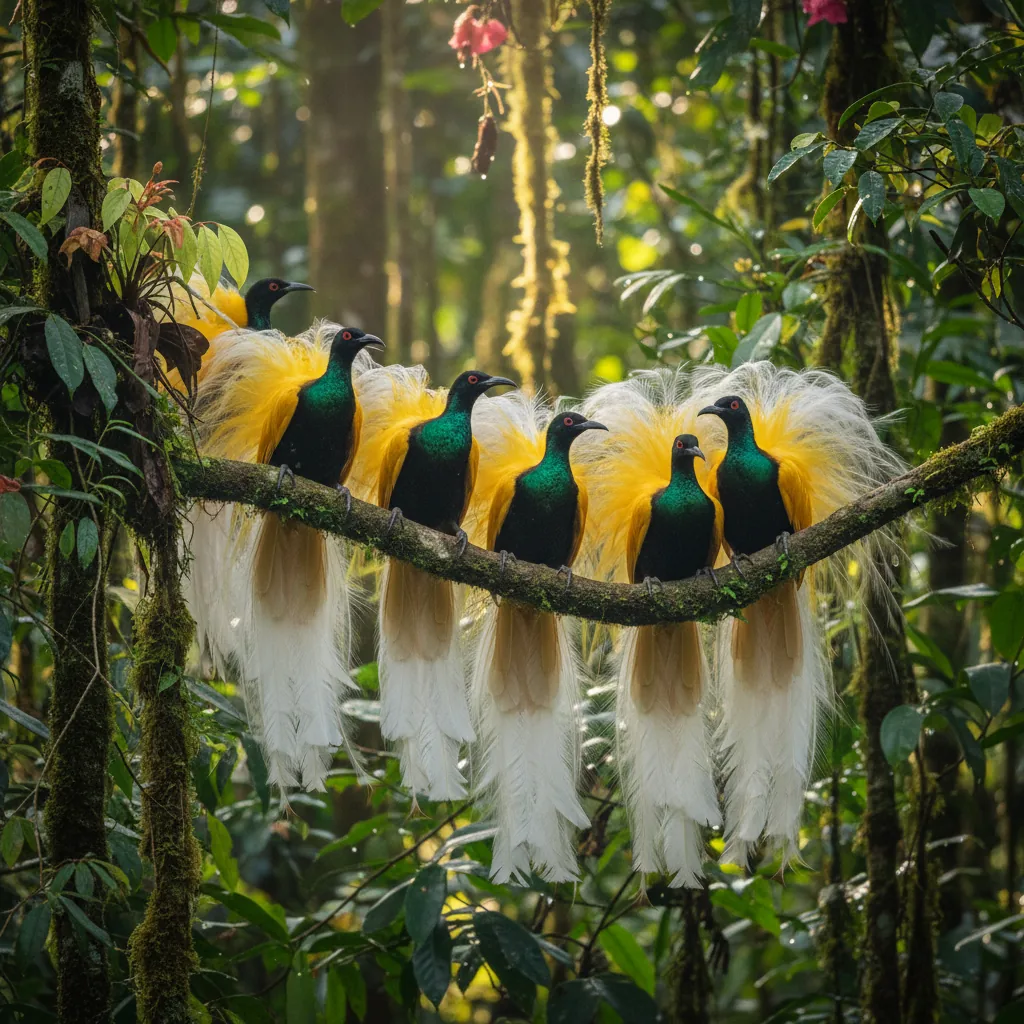
The Greater Bird of Paradise (Paradisaea apoda) is the bird that gave the entire family Paradisaeidae its name and its legend. When the first skins of this species arrived in Europe in the 16th century, the absence of feet in the prepared specimens — traders removed the legs to preserve the plumes — led naturalists and philosophers to declare these birds must be creatures of paradise itself, never touching the Earth. Linnaeus immortalised this myth by naming the species ‘apoda’, meaning ‘footless’. The Greater Bird of Paradise remains today the most iconic representative of an extraordinary radiation of 42 species that evolved exclusively in the forests of New Guinea and surrounding islands.
The Spectacular Display
The male Greater Bird of Paradise is a dramatic figure: a yellow head, dark maroon body, iridescent emerald-green throat, and — most spectacularly — a cascade of pale yellow and white flank plumes that can exceed 50 cm in length. During display at communal lek trees, males raise these plumes over their backs while calling in a rich, nasal chorus, creating a shimmering cloud of golden feathers that moves in synchrony with each bird’s posturing. When 10 or more males display simultaneously, the visual impact is overwhelming.
Behaviour & Biology
The Aru Islands — located south of the New Guinea mainland in the Banda Sea — represent the southernmost range of the Greater Bird of Paradise and have been a pilgrimage site for ornithologists since Alfred Russel Wallace first documented the species there in 1857. Wallace’s account in ‘The Malay Archipelago’ remains one of the most vivid descriptions of a bird of paradise display ever written, and the same lek sites he visited continue to be productive today.
Where & How to See Greater Bird of Paradise in Papua
Our tours to see the Greater Bird of Paradise typically combine a flight to Dobo (the main town in the Aru Islands) with local boat travel to rainforest villages where community rangers monitor active lek trees. The multi-day format allows multiple dawn visits, maximising your chances of witnessing a full-scale group display.
Photography Tips for Bird of Paradise
Photographing the Greater Bird of Paradise requires patience, preparation, and the right equipment. We recommend arriving at lek sites at least 30 minutes before first light to allow the forest to settle before birds begin arriving. Avoid sudden movements, keep voices to a whisper, and dress in dark, neutral colours. A telephoto lens of 400-600mm is ideal for frame-filling shots; image stabilisation is essential in the low forest light. Our photography-focused tours include custom hide setups at active lek sites, allowing extended close-range sessions that produce magazine-quality imagery.
Camera settings to start with: ISO 800-3200 (adjust for light conditions), aperture f/4-f/5.6 (balance depth of field and light), shutter speed 1/250s minimum for freezing display movement. Shoot in RAW format for maximum post-processing flexibility. Our guides can advise on optimal settings for each specific location and time of day.
Conservation Status & Threats
Like all birds of paradise, the Greater Bird of Paradise faces mounting pressure from deforestation and habitat degradation. While the IUCN currently lists many species as Least Concern, population trends are downward in areas experiencing forest clearance for agriculture, logging, and palm oil development. Traditional hunting for feather headdresses, while greatly reduced since international protection in the 1920s, continues in some communities for ceremonial use.
Sustainable ecotourism represents one of the most powerful conservation tools available today. When local communities receive genuine economic benefit from living birds watched by tourists, they become the most effective guardians of both forest and wildlife. Every tour booked with Papua Bird of Paradise directly supports community ranger programmes, forest patrol activities, and local conservation education initiatives.
Our Bird Watching Tour Options
We offer a range of bird watching experiences tailored to different interests, timeframes, and fitness levels. Short 3-4 day introductory packages focus on one or two species at accessible lowland sites. Week-long comprehensive tours cover multiple habitats and species. Photography expeditions of 10-14 days include custom hides, multiple lek visits, and professional photography guidance from our specialist naturalist guides.
All our tours include: expert ornithologist-naturalist guide with 10+ years Papua field experience, community ranger accompaniment at lek sites, all local transport (chartered boat, 4WD, porter support), meals and accommodation (ranging from village homestays to luxury jungle lodges), all park and community entry fees, and 24/7 support via WhatsApp. Contact us at sales@balipremiumtrip.com or WhatsApp +628113809193 to discuss a custom itinerary.
Frequently Asked Questions
Why is the Greater Bird of Paradise called ‘apoda’ (footless)?
The name refers to the historical practice of early Malay traders who prepared bird skins for export by removing the feet, leading European naturalists to believe the birds had no legs and must live permanently airborne in paradise. This myth persisted in European literature for nearly a century after first contact.
Is Alfred Russel Wallace’s lek site still active?
The Aru Islands sites documented by Wallace in the 1850s have changed due to deforestation, but similar lek sites in traditional forest areas remain active. Local community rangers track these sites and our tours work with them for guaranteed access.
How does the Greater Bird of Paradise compare to the Lesser?
The Greater is larger, has longer and more voluminous plume extensions, and typically produces more imposing group displays. The Lesser is more widely distributed and often easier to access. For the most dramatic display experiences, the Greater in the Aru Islands is the premium sighting.
Can I reach the Aru Islands easily?
Regular flights connect Dobo (Aru Islands) to Ambon, from where connections to major Indonesian cities are available. The journey requires advance planning — our tour packages handle all logistics including permits, accommodation, and local community coordination.
What conservation threats face the Greater Bird of Paradise?
Habitat loss through deforestation for palm oil and agricultural expansion poses the primary threat. Historically, the plume trade nearly decimated the species before international protection in the 1920s. Today, sustainable ecotourism is the most effective conservation tool.
Ready to See Birds of Paradise in the Wild?
Let our expert naturalist guides take you deep into Papua’s rainforests for a life-changing wildlife encounter. All tours include expert ornithologist guide, chartered boat, meals, and full logistics support.